
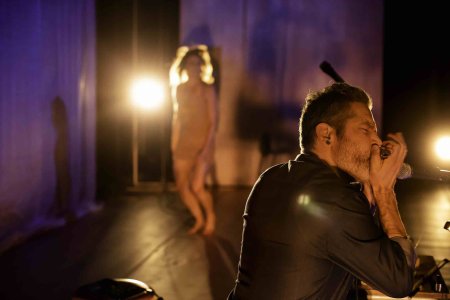
'Paradise Blues is an exceptional piece, no shortcomings and no excesses.' Hilke Pattyn (Veto)
"It started in Center Parcs," Jessa Wildemeersch reveals. That is where her desire arose to know what comes after this life. It started with counting. Every second counted there is a second closer to death.
With Paradise Blues, Wildemeersch provides an overview of her search for heaven, or whatever comes after death. Her insatiable curiosity about the hereafter creates a palpable tension not to have to die immediately.
In her search for answers she spoke with different people: young and old, male or female, religious or not, she registered all voices with her iPad. They form the guideline throughout the piece.
In contrast to Center Parcs, the decor is less child-friendly. Several empty surfaces are immersed in a soft light. They go hand in hand with a maze of threads and remarkable musical instruments.
Paradise Blues is an exceptional piece, no shortcomings and no excesses.
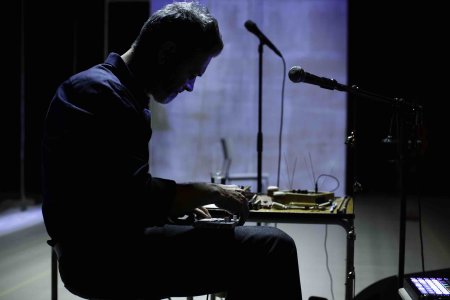
Wildemeersch is flanked by Steven De bruyn at the start of the play. His soft words make his music sound all the more powerful. The alternation between the electronic harmonica sound and the soft atmospheric music provides structure in the piece.
The music is enhanced by an increasingly cool light. The atmosphere builds up and the encounter between Jessa and the dubious Italian archaeologist Fabio blurs the line between a travel story and brainwaves.
In a villa on a small island in Italy, Wildemeersch makes an effort to organize her thoughts. With the image of gently splashing water in the background, she describes the moment when she realizes that she needs to revise her idea about the hereafter. Wildemeersch makes it clear that to think about the afterlife you also have to think about death. You cannot skip a step.
Wildemeersch' tumultuous search is seamlessly illustrated by the mysterious music of De bruyn
Supported by a confusing combination of Italian gelato and a white shepherd dog, she becomes increasingly involved. Her sometimes tumultuous search is seamlessly illustrated by the mysterious music of De Bruyn and Wildemeersch’ excellent acting performance.
As a spectator you lose track of time and it feels like you are in Italy with Wildemeersch and De bruyn. The combination of a staggering story and extraordinary atmosphere creates an exceptional piece, no shortcomings and no excesses.
What initially starts as a chronological summary of the making of a theater piece, ends in a dwindling reality that makes us fantasize. As spectators, we are left with a bemused feeling after the performance. Does the picturesque villa really exist, does the charming Fabio really exist, but above all: does the hereafter really exist?
03/12/2019
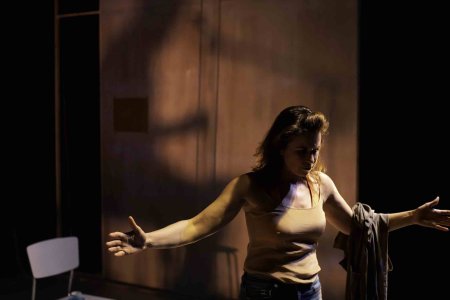
Jessa Wildemeersch shares her insights about the creation Paradise Blues on national radio.
This text is an assemblage of a broadcast on Radio 1 and Klara
It started with the book Sum: 40 tales of the afterlife, by American neurologist David Eagleman. A delightful description of 40 possible heavens. The afterlife became my starting point, an inspiring motive.
In the research and development phase for a new performance, I always start from the unknown. When talking to people I discover new insights and realize how much I don’t know.
I collected many different perspectives, interviewed a diverse group of people from different countries, with contrasting cultural and religious backgrounds. I came to one conclusion: There are as many possible heavens as there are people.
How people reflect on the afterlife has got a lot to do with how they live their lives.
During my R&D phase I realized: ‘I am ignoring death.’ And it came back at me, I suddenly understood , to get to the afterlife you must die first. That speaks for itself, but it confronted me with my own fear of dying. There is this existential void that we all feel. A professor of Italian studies at NYU, specialized in Dante’s work, gave me this beautiful quote: ‘We all have something sacred and we are all in the dark wood, looking for a path.’
I registered all the interviews, this allowed me to listen to the recordings, reflect upon them, cut and paste. The source material is tangible. I love the way people speak, the rhythm, the sound, the musicality of language,…
After 40 interviews I needed to retreat. Flanders Literature awarded me with a writing residency on an island in Lake Como, Italy. Because of a storm I could not get to the Island and had to stay one night in Milan. I met Fabio, an Italian archeologist. I spoke with him and thought: ‘ the archeological perspective on the afterlife is missing in my research’. However Fabio didn’t allow me to record him. My working method fell apart.
Because I could not register his story, I started to look and listen differently. I started to absorb his story sensorially instead of counting on registered documents.
My journey came to a tipping point. Meeting the archeologist propelled me forward into a trip. I was challenged to search for my own perspective on paradise.
In the final performance some of the interviews are woven in, but they don’t take a prominent place. The story takes on a different turn. The journey to the island and the search for my paradise is expressed sensorially, through live music, film and poetry.
03/12/2019
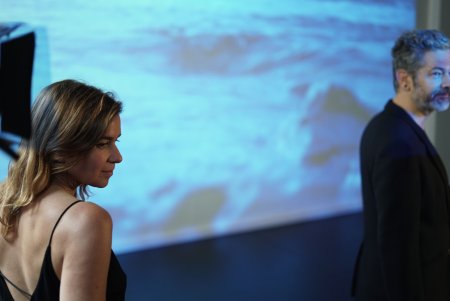
‘Not a dance of death, but instead a bluesy party.’
Els Van steenberghe (Knack)
Paradise Blues is Jessa Wildemeersch’ recent travelogue. ’Travelogue’, yes. Wildemeersch is fond of theater and travelling. That’s why she often does her research while traveling. In 2018 she went to Russia, with two actresses, in search of the Russian soul and Chekhov’s Three Sisters.
Their play The Boar is watching us was an ingenious mix of travelogue and crisp, exciting repertoire theatre. Paradise Blues is inspired by Wildemeersch’ residence on an Island in Lake Como and the meeting with an Italian archeologist. She writes, directs and plays together with harmonica musician Steven De bruyn. His music guarantees that this piece is not a dance of death, but instead a bluesy party.
03/12/2019
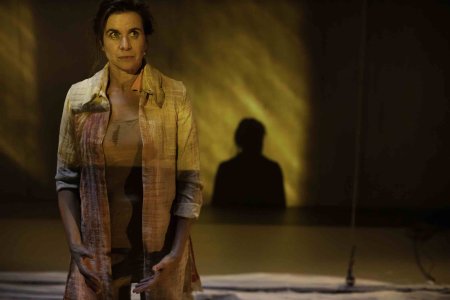
‘Become invisible, occasionally’
Jessa Wildemeersch shares her life lessons.
Ines Minten (De Standaard)
‘As an actress I stand in the limelight, that’s part of my job. It is important to be visible both on and off-stage. Eventually our whole modern society is based on visibility. Therefore I like to become invisible once in a while. It is not only about putting away my cell phone and staying away from social media. I am also talking about the importance of wandering around the city, becoming silent, to merge with the crowd and with life. That’s how I learn to look again, to stay bewildered, just by observing how the light hits a building. This demands time and attention. By becoming invisible, by looking, feeling, smelling, you allow the world to become visible.’
‘ For my new play, Paradise Blues, I interviewed a lot of people about their vision on the afterlife, I registered these encounters with an audio recorder. In Italy I met an archeologist who did not want to be recorded. That was a lesson. A recording is like a handle, something you can always go back to and listen. But here, I had to let go, just listen and allow the words to penetrate. I like to capture beauty, I like to hold on to beautiful things, I even write diaries. But once in a while you have to stop recording and trust. What needs to stay with you eventually will. This allows you to sharpen your senses.’
03/12/2019
Reactions on social media:
‘Two incredible clever artists’ Tuur Florizoone (musician) ‘A deeply moving performance’ Els Dekeukelaere
‘An intimate masterpiece.’ Sara Bomans (visual artist)
'In a wonderfully playful manner and with childlike wonder, Jessa opens up all registers of the human imagination and takes us on her search for answers, which she finds all over the world, but which of them are correct? (...)
Steven's musical interpretation gives the play wings. If good visual art were to be heard, it would sound like the soundscapes and songs made for this piece. The music scrubs and speaks in an unctuous tone, carries you and pulls the tears from your body. The songs are small and large, raw and soft.
Paradise Blues is an intimate masterpiece, probing the core of your existence, without being heavy. It is authentic, substantial and funny.
03/12/2019
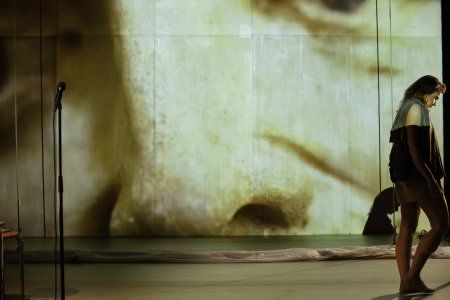
Paradise Blues premiered in full social unrest, while the Flemish government announced up to 60% cuts in the Arts Funding. Jessa Wildemeersch uses her voice to react to this devastating news on radio
‘The creation of beauty is so essential, and beauty in all its forms, also in vulnerability. And what happens to a society where beauty is silenced, or where vulnerability should not exist, I wonder, what does that say about policy makers? ... "
Listen to the full interview (in Dutch) : https://klara.be/pompidou-dinsdag-12-november-2019?fbclid=IwAR0tGs8AtMZ74MBC8WjmPQWML6imLYyj8WtxkfCduAvrfzK6LNcOYEkE2yc
03/12/2019
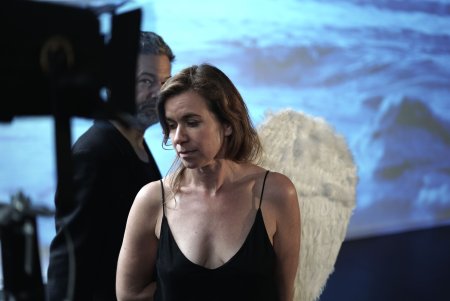
Interview with Jessa Wildemeersch
by Ana Van Liedekerke , Remo Verdickt (Veto Magazine)
Paradise Blues brought theater maker Jessa Wildemeersch from paradise to inferno and back. Her new play opens right in the middle of the cultural subsidy collapse. "I joined the protest the same day my new play premiered."
'Storytelling is a hip phenomenon. It is used in every possible way by in the corporate and advertising world. But always to generate benefits, to create effect. Storytelling to convince people or support a bank. "
'In the arts, on the other hand, people tell stories without an aim for profit. There is a kind of giving without having to get something in return. I think if we stop doing that as a society - giving without expecting anything in return - we will suffocate, it will be hell for our children. That is why it is necessary to invest in art. "
read full interview (in Dutch) http://www.veto.be/artikel/jessa-wildemeersch-mijn-hemel-ontbreekt
03/12/2019